
Cross Belt Sampling Systems
McLanahan Cross Belt Sampling Systems
Representative Sampling Directly from Conveyor Belts
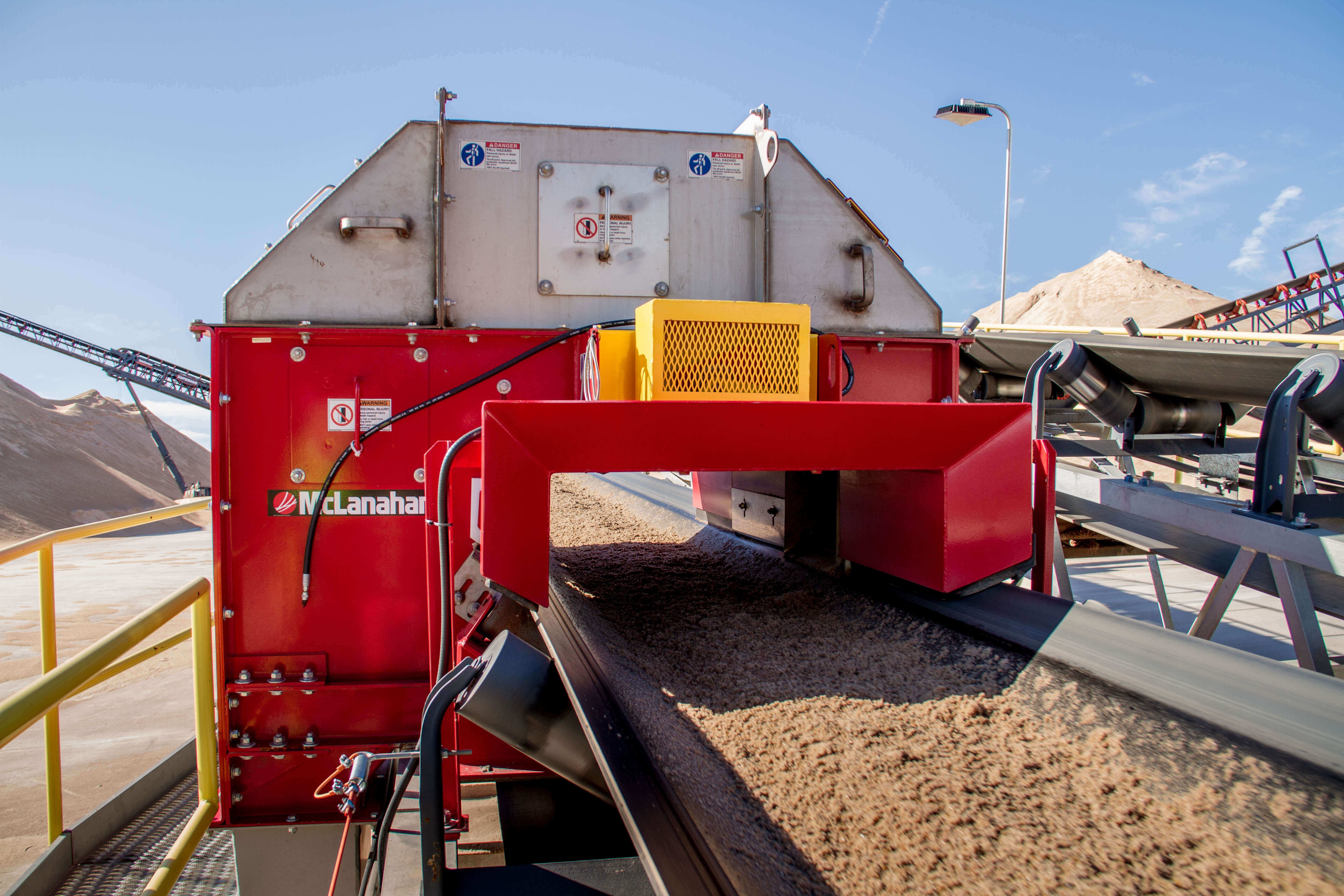
McLanahan Cross Belt Sampling Systems are designed to automatically collect representative samples from bulk material conveyed on a moving belt.
The system is suitable for applications where accurate sampling of a continuous material stream is required for quality control, process monitoring, laboratory analysis and production accounting.
A cross-belt sampler travels across the full width of the material burden on the conveyor, collecting an increment from the complete cross-section of the material stream. This helps minimize sampling bias that can occur when samples are collected from only one portion of the conveyor.
How Cross Belt Sampling Systems Work
The Cross Belt Sampler is installed above or around the conveyor belt at the selected sampling location.
During a sampling cycle, the sampler moves across the full width of the conveyor belt and collects a portion of the material.
After completing the sampling pass, the collected material is transferred to the sample handling system.
Depending on the application, the sample can then be:
Cross Belt Sampler → Sample Transfer → Secondary Sampling → Crushing → Sample Division → Final Sample
The exact configuration depends on the material characteristics, conveyor capacity, particle size and laboratory requirements.
Full-Stream Cross-Belt Sampling
One of the key advantages of cross-belt sampling is the ability to collect material across the complete width of the conveyor burden.
Material can segregate on a conveyor according to particle size, density and other physical characteristics.
Collecting material from only one location can therefore produce a sample that does not accurately represent the complete material stream.
By traversing across the conveyor, the Cross Belt Sampler can collect material from different portions of the burden and provide a more representative sample.
Representative Sampling
Representative sampling is critical when laboratory results are used to make decisions about the material being processed.
A properly designed Cross Belt Sampling System helps reduce sampling errors associated with:
-
Particle segregation
-
Variable particle size
-
Variable material density
-
Uneven material distribution
-
Changes in material composition
-
Manual sampling locations
The sampler should be designed according to recognized sampling principles and the specific characteristics of the material and process.
Sampling from a Moving Conveyor
Cross Belt Sampling Systems are designed to operate with the conveyor running.
This allows samples to be collected from a continuous production stream without requiring the conveyor to be stopped.
The sampling cycle can be initiated according to a predetermined schedule or sampling requirement.
Sampling frequency can be based on:
-
Time
-
Tonnage
-
Production quantity
-
Batch
-
Process conditions
Automated Sampling
The Cross Belt Sampling System can be integrated into the plant control system to automate the sampling process.
Automation reduces operator involvement and provides consistent sampling according to the selected sampling schedule.
Benefits of automated sampling include:
-
Consistent sampling frequency
-
Reduced manual intervention
-
Improved repeatability
-
Improved operator safety
-
Better process monitoring
-
Reduced sampling variability
-
Integration with plant control systems
Sample Handling and Preparation
The Cross Belt Sampler can form part of a complete automated sample preparation system.
After the primary sample is collected, additional equipment can be incorporated to prepare the material for laboratory analysis.
Depending on the application, the sample preparation system may include:
-
Secondary samplers
-
Crushers
-
Screens
-
Sample dividers
-
Collection containers
-
Conveyors
-
Dust-control equipment
The objective is to reduce the original bulk material stream to a manageable laboratory sample while maintaining representative material characteristics.
Primary and Secondary Sampling
The Cross Belt Sampler normally performs the primary sampling function by extracting an increment from the main conveyor stream.
Where a smaller laboratory sample is required, a secondary sampling stage can be incorporated.
The secondary sampler reduces the quantity of material while maintaining representative characteristics.
Multiple stages can be used when a large production stream must ultimately be reduced to a small laboratory sample.
Sample Crushing
Some applications require the primary or secondary sample to be reduced in particle size.
A crusher can be incorporated into the sample preparation circuit to reduce the material to the required size.
Sample crushing can make subsequent sample division more consistent and prepare the material for laboratory analysis.
Crusher selection depends on:
-
Maximum feed particle size
-
Material hardness
-
Material abrasiveness
-
Required product size
-
Sample capacity
Sample Division
After the material has been reduced in size, a Sample Divider can be used to produce smaller representative portions.
Proper sample division is important because the final laboratory sample must continue to represent the original material stream.
The sample divider can be selected according to the required sample mass, particle size and material characteristics.
Sampling Frequency and Increment Size
The required sampling frequency and increment size depend on the material and the purpose of sampling.
Important considerations include:
-
Conveyor capacity
-
Material variability
-
Particle size
-
Material density
-
Required analytical accuracy
-
Required final sample mass
-
Production rate
-
Laboratory requirements
A sampling program should be established to provide sufficient increments to represent the variability of the material over the required production period.
Applications
McLanahan Cross Belt Sampling Systems can be used for:
-
Mining
-
Mineral processing
-
Coal handling
-
Aggregates
-
Industrial minerals
-
Bulk material handling
-
Mineral laboratories
-
Quality control
-
Process monitoring
-
Production accounting
-
Metallurgical accounting
-
Material characterization
-
Continuous process sampling
Typical Materials
Cross Belt Sampling Systems can be configured for a wide range of bulk materials, including:
-
Ores
-
Coal
-
Aggregates
-
Sand
-
Minerals
-
Industrial minerals
-
Concentrates
-
Other bulk solid materials
The final system configuration depends on the material's physical and chemical characteristics.
Key Features & Benefits
-
Automated sampling from moving conveyor belts
-
Sampling across the conveyor material burden
-
Representative primary sampling
-
Reduced manual sampling requirements
-
Consistent sampling frequency
-
Improved sampling repeatability
-
Suitable for continuous production streams
-
Can be integrated with sample preparation equipment
-
Optional secondary sampling
-
Optional sample crushing
-
Optional sample division
-
Integration with plant control systems
-
Improved operator safety
-
Suitable for laboratory sample preparation
-
Configurable for different conveyor and material conditions
Factors Affecting Cross Belt Sampler Selection
The correct Cross Belt Sampling System depends on several process and material parameters, including:
-
Material type
-
Bulk density
-
Maximum particle size
-
Particle size distribution
-
Material moisture
-
Material hardness
-
Material abrasiveness
-
Conveyor belt width
-
Conveyor belt speed
-
Material burden depth
-
Conveyor capacity
-
Sampling frequency
-
Required sample mass
-
Required final sample size
-
Sampling location
-
Conveyor configuration
-
Available installation space
Designing the Right Cross Belt Sampling System
To properly design a Cross Belt Sampling System, the following information is typically required:
-
Material description
-
Bulk density
-
Capacity
-
Maximum particle size
-
Particle size distribution
-
Moisture content
-
Material hardness
-
Material abrasiveness
-
Conveyor belt width
-
Conveyor speed
-
Material burden depth
-
Sampling frequency
-
Required increment mass
-
Required final sample mass
-
Sampling location
-
Conveyor arrangement
-
Available installation space
-
Required level of automation
-
Laboratory requirements
Representative material testing may also be recommended where material characteristics are uncertain or where high sampling accuracy is required.
McLanahan Cross Belt Sampling Systems from Cube Solutions
As a McLanahan agent, Cube Solutions provides automated sampling solutions for mining, mineral processing, coal, aggregates and bulk material handling applications.
Our team can evaluate your material characteristics, conveyor conditions and laboratory requirements and assist in selecting the appropriate McLanahan Cross Belt Sampling System.
Contact Cube Solutions to discuss your conveyor sampling requirements and develop a reliable solution for representative and automated material sampling.