
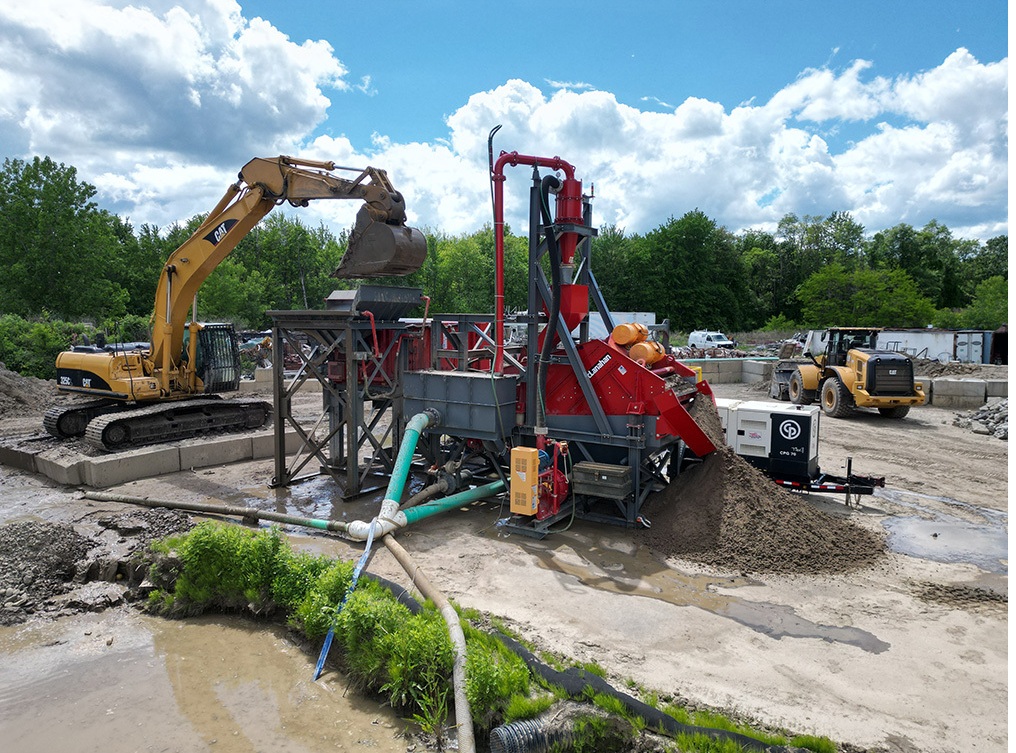
Hydrovac Waste Recycling Systems
McLanahan Hydrovac Waste Recycling Systems
Transforming Hydrovac Waste into Valuable Recovered Products
McLanahan Hydrovac Waste Recycling Systems are configurable processing solutions designed to recover and wash valuable aggregate materials from hydrovac waste streams.
Hydrovac excavation uses high-pressure water and vacuum equipment to safely expose underground utilities and excavate soil. The resulting waste is a slurry containing water, soil, sand, gravel, rock, organic material and other debris.
Instead of sending this material to a landfill or disposal facility, McLanahan's Hydrovac Waste Recycling Systems separate, wash and dewater the material to recover usable products such as clean sand, rock and gravel while also recovering process water for reuse.
This approach helps transform a difficult waste stream into a valuable resource while reducing disposal requirements and supporting more sustainable operations.
How Hydrovac Waste Recycling Systems Work
Hydrovac slurry is discharged directly from hydrovac trucks into a receiving hopper.
The system separates the coarse material from the fine material and water, washes the recovered aggregate and sand, dewaters the final products and processes the wastewater for water recovery.
A typical process flow is:
Hydrovac Truck → Feed Hopper → Trommel Screen → Sand Classification → Double Sand Washing → Dewatering → Water Recycling → Solids Dewatering
The exact configuration can be adapted according to the characteristics of the hydrovac waste and the required final products.
Receiving Hopper
The Hydrovac Waste Recycling System incorporates a dual-bay receiving hopper designed to accept slurry from hydrovac trucks.
The dual-bay arrangement allows the system to receive material from two trucks at a time, helping maintain a continuous feed to the processing plant.
The hopper incorporates features designed to assist truck operators during unloading, including weight cables embedded in the offloading ramp and strobe lights indicating when the truck is ready to unload.
Trommel Screening
The hydrovac slurry enters a Rotary Trommel Screen for the initial separation of coarse material from fine material and water.
As the Trommel rotates, the material tumbles through the drum while internal spray bars rinse the coarse aggregate.
The smaller particles and water pass through the screening openings into a sump, while the larger rock and gravel continue through the drum and are discharged from the end.
The combination of tumbling action and internal spray bars also provides a light scrubbing action that helps clean the coarse aggregate.
External spray bars rinse the screening panels and help prevent plugging.
Rotary Trommels are particularly suitable for hydrovac slurry because they can handle the high water content and large slurry volumes associated with hydrovac waste.
Sand Classification
The fine material and water collected beneath the Trommel are pumped to a Separator™, which provides the first stage of the sand washing process.
The Separator™ classifies the sand and separates it from:
-
Silt
-
Clay
-
Fines
-
Topsoil
-
Other unwanted lightweight material
The unwanted fine material and much of the water report to the water recycling circuit, while the desired sand continues to the second washing stage.
McLanahan uses a Separator™ rather than a conventional Hydrocyclone in its Hydrovac systems because the Separator™ is better able to handle variations in feed solids concentration and large volumes of water that are characteristic of hydrovac waste.
Double Sand Washing
McLanahan Hydrovac Waste Recycling Systems use two stages of sand washing.
The first stage is performed by the Separator™, followed by a Fine Material Screw Washer as the second washing stage.
This double-washing arrangement produces a cleaner sand product that can potentially be used in a wider range of applications.
Fine Material Screw Washer
The Fine Material Screw Washer receives the classified sand from the Separator™.
The material enters the pool area of the screw washer, where an upward current of water helps keep lighter fine particles suspended.
The heavier and larger sand particles settle and are conveyed upward by the rotating screw.
As the sand travels up the inclined deck, excess water drains from the material before it reaches the discharge.
The Fine Material Screw Washer provides flexibility in controlling the final sand specification and can also help remove lightweight organic material.
Dewatering Screen
After the second washing stage, the clean sand is discharged onto a Dewatering Screen.
The Dewatering Screen removes excess water from the sand before stockpiling.
The result is a relatively dry, drip-free sand product that is easier to handle, transport and stockpile.
Reducing free water in the stockpile can also improve site housekeeping by minimizing water draining from material piles.
Water Recycling
Water recovered during the washing process contains suspended solids including fines, silt, clay and topsoil.
Instead of disposing of this wastewater, it can be processed through the water recycling portion of the system.
The wastewater is pumped to a Thickener, where suspended solids are separated from the liquid.
The clarified liquid overflows into a holding tank for reuse, while the thickened solids are sent to the next stage of solids separation.
This closed-loop approach allows a significant portion of the process water to be recovered and reused in hydro excavation or site housekeeping activities.
Thickener
The Thickener receives wastewater containing suspended solids.
Polymers can be added to promote flocculation, causing fine suspended particles to form larger flocs that settle more efficiently.
The settled solids are moved toward the center of the Thickener by the rake mechanism and discharged as thickened underflow.
The clarified water flows over the Thickener weirs and into a holding tank for reuse.
McLanahan systems can incorporate automatic flocculation and controls for monitoring Thickener performance, including flow meters and ultrasonic density meters.
Decanter Centrifuge
The Thickener underflow can be further processed through a Decanter Centrifuge to achieve additional liquid-solid separation.
The centrifuge uses centrifugal force to separate the solids from the liquid.
The solids are conveyed toward the solids discharge and can be discharged in a drip-free condition suitable for mechanical handling.
The separated liquid is returned to the holding tank and can be reused.
Decanter Centrifuges are particularly useful for hydrovac waste because they can handle difficult clays and variations in feed composition.
Closed-Loop Water Management
Hydrovac waste contains a large amount of water because high-pressure water is used during excavation.
Effective water management is therefore a critical part of hydrovac waste recycling.
A closed-loop system can:
-
Recover process water
-
Reduce fresh-water consumption
-
Provide water for reuse in hydro excavation
-
Provide water for cleaning and housekeeping
-
Reduce wastewater disposal
-
Reduce the amount of liquid sent off site
-
Improve overall site sustainability
Depending on local regulations and water quality requirements, additional water treatment can also be incorporated into the system.
Recovering Valuable Products from Waste
The primary objective of the Hydrovac Waste Recycling System is to convert waste into usable products.
Depending on the feed material and system configuration, recovered products can include:
-
Clean sand
-
Gravel
-
Rock
-
Recycled aggregate
-
Other usable mineral material
The recovered materials can potentially be sold or reused in construction-related applications, reducing the amount of material requiring disposal.
Reducing Disposal Costs
Traditional hydrovac waste management can involve transportation to approved disposal facilities and associated tipping or disposal fees.
Recycling the material on site can reduce the amount of waste requiring disposal.
This can provide economic benefits by:
-
Reducing transportation requirements
-
Reducing disposal fees
-
Recovering saleable aggregate products
-
Increasing the amount of hydrovac waste that can be accepted
-
Reducing landfill dependency
A McLanahan case study at Greenwood Farms demonstrated the recovery of usable aggregate and sand from hydrovac waste, with the system processing approximately eight to ten hydrovac truckloads per day at that facility.
Modular and Compact Design
McLanahan Hydrovac Waste Recycling Systems use a modular approach that allows the system to be configured according to the available footprint and processing requirements.
The system can also be designed around gravity flow, reducing the amount of pumping required and helping minimize power requirements.
For sites with height restrictions, McLanahan can design a lower-profile configuration to suit specific site requirements.
Flexible System Configuration
The system can be configured with different processing stages depending on the feed material and desired products.
Optional stages can include:
-
Coarse material scrubbing
-
Additional washing
-
Tailings management
-
Water treatment
-
Additional dewatering
This allows the Hydrovac Waste Recycling System to be designed specifically around the customer's material and operating requirements.
Applications
McLanahan Hydrovac Waste Recycling Systems are suitable for:
-
Hydrovac waste recycling
-
Hydro excavation waste
-
C&D recycling
-
Excavation waste
-
Aggregate recovery
-
Sand recovery
-
Rock and gravel recovery
-
Construction waste recycling
-
Water recycling
-
Waste reduction
-
Sustainable construction operations
Key Features & Benefits
-
Designed specifically for hydrovac slurry
-
Twin receiving hopper
-
Can receive waste from two hydrovac trucks at a time
-
Rotary Trommel for initial separation
-
Internal spray bars for material rinsing
-
Light scrubbing of coarse aggregate
-
Separator™ for sand classification
-
Two-stage sand washing
-
Fine Material Screw Washer
-
Dewatering Screen
-
Thickener for water clarification
-
Decanter Centrifuge for additional dewatering
-
Automated flocculation system
-
Water recycling
-
Drip-free recovered sand and solids
-
Modular system configuration
-
Compact footprint
-
Gravity-flow design options
-
Optional coarse scrubbing
-
Optional tailings management
-
Reduced waste disposal
-
Reduced transportation costs
-
Recovery of saleable aggregate materials
-
Reduced fresh-water requirements
Factors Affecting System Performance
Hydrovac waste can vary significantly from one truckload to another.
Important factors affecting system design and performance include:
-
Number of hydrovac trucks per hour
-
Feed volume
-
Feed solids concentration
-
Water content
-
Particle size distribution
-
Sand content
-
Gravel and rock content
-
Clay content
-
Silt content
-
Organic material
-
Contaminants
-
Required sand specification
-
Required aggregate products
-
Required water recovery
-
Site footprint
-
Available water
-
Local water-disposal regulations
-
Required level of automation
Because hydrovac waste is highly variable, McLanahan recommends representative material testing to establish the appropriate equipment configuration and operating parameters.
Designing the Right Hydrovac Waste Recycling System
Important information for system design includes:
-
Number of hydrovac trucks per hour
-
Average slurry volume per truck
-
Average feed solids concentration
-
Water content
-
Feed particle size distribution
-
Percentage of sand
-
Percentage of coarse aggregate
-
Clay and silt content
-
Organic content
-
Contaminants present
-
Required final products
-
Required sand quality
-
Required aggregate quality
-
Required water recovery
-
Available site area
-
Site height restrictions
-
Available power
-
Available water
-
Water discharge requirements
-
Required operating hours
-
Desired level of automation
McLanahan can use representative samples and laboratory testing to help determine the appropriate equipment size, quantity and configuration for the application.
McLanahan Hydrovac Waste Recycling Systems from Cube Solutions
As a McLanahan agent, Cube Solutions provides complete solutions for hydrovac waste recycling, aggregate recovery, sand washing, dewatering and water management.
Our team can evaluate your hydrovac waste characteristics, required recovered products, water-recycling requirements and site conditions and assist in selecting the appropriate McLanahan Hydrovac Waste Recycling System.
Contact Cube Solutions to discuss your hydrovac waste recycling project and transform your waste stream into valuable recovered products and reusable process water.