
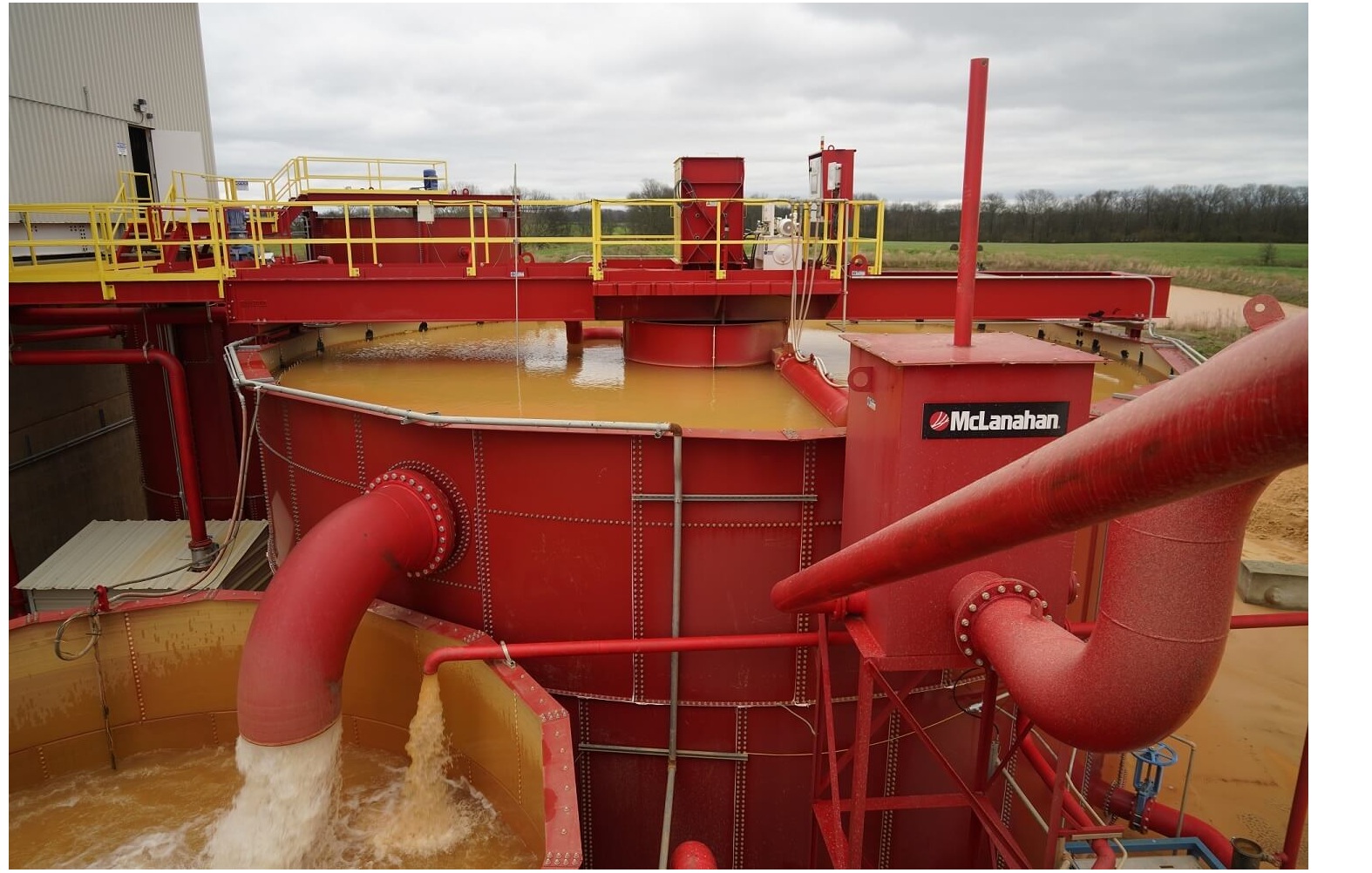
McLanahan Thickeners
McLanahan Thickeners
Efficient Slurry Thickening and Process Water Recovery
McLanahan Thickeners are designed to separate solids from water and increase the concentration of solids in slurry streams.
Thickeners are an important part of wet-processing plants, particularly in mining, aggregates, coal and mineral processing applications where large volumes of process water must be recovered and reused.
By settling suspended solids and producing a concentrated underflow, while producing a clarified overflow, McLanahan Thickeners help reduce water consumption, improve water recycling and minimize the amount of material sent to settling ponds or downstream dewatering equipment.
How Thickeners Work
A Thickener receives a slurry containing suspended solids and water.
The feed enters the thickener and is distributed into the settling zone. As the slurry moves through the tank, solid particles settle toward the bottom under gravity.
The clarified water rises toward the surface and is collected as overflow.
At the bottom of the thickener, the settled solids form a concentrated sludge or underflow. A rake mechanism moves the settled solids toward the center discharge point, where the thickened slurry is pumped to the next stage of the process.
The basic process can be summarized as:
Slurry Feed → Settling → Clarified Water Overflow + Thickened Solids Underflow
The clarified overflow can typically be returned to the process as recycled water, while the thickened underflow can be sent to a Filter Press, centrifuge, tailings system or other downstream dewatering equipment.
Water Recovery
One of the primary functions of a Thickener is to recover process water.
Instead of allowing water containing suspended solids to report directly to a settling pond, the Thickener separates much of the water from the solids.
The recovered clarified water can be returned to the washing or processing circuit.
This can help:
-
Reduce fresh-water consumption
-
Increase process-water recycling
-
Reduce water losses
-
Reduce the volume of water sent to ponds
-
Improve overall water management
-
Support closed-loop processing systems
Thickened Underflow
The solids that settle at the bottom of the Thickener form a concentrated underflow.
Compared with the original feed slurry, the thickened underflow contains a significantly higher concentration of solids and a lower percentage of free water.
This makes the underflow easier and more economical to handle in downstream processes.
The thickened underflow can be directed to:
-
Filter Presses
-
Centrifuges
-
Tailings storage
-
Backfill systems
-
Further mineral processing
-
Other dewatering equipment
Rake Mechanism
The Thickener rake mechanism continuously moves settled solids toward the central discharge area.
The rake helps maintain an effective settling bed and prevents solids from accumulating unevenly within the tank.
Depending on the application, rake design and operating parameters can be selected according to:
-
Slurry density
-
Solids loading
-
Material characteristics
-
Settling properties
-
Required underflow density
-
Tank diameter
The rake drive system is designed to provide controlled and reliable operation under varying solids loads.
High-Density Slurry Handling
McLanahan Thickeners can be used where a high concentration of solids is required in the underflow.
The design of the thickener and its operating conditions can be optimized according to the characteristics of the material and the desired underflow density.
Proper control of feed distribution, settling conditions, rake operation and underflow withdrawal is important for maintaining stable performance.
Clarified Overflow
The water collected from the upper portion of the Thickener is clarified compared with the original feed slurry.
This overflow can be reused as process water when its quality meets the requirements of the washing or processing circuit.
Water clarification can reduce the amount of suspended solids returned to the process and help improve overall water quality.
Integration with Filter Presses
Thickeners are commonly installed upstream of mechanical dewatering equipment.
A typical tailings dewatering circuit can be:
Wash Plant → Thickener → Thickened Underflow → Filter Press → Filter Cake
The Thickener first concentrates the solids and removes a large portion of the water.
The concentrated underflow is then fed to the Filter Press, which mechanically removes additional water and produces a filter cake.
This combination provides an effective approach to water recovery and tailings dewatering.
Reducing Settling Pond Requirements
By recovering water and concentrating solids before they reach a settling pond, Thickeners can reduce the load placed on ponds.
Depending on the application and overall process design, this can help:
-
Extend pond life
-
Reduce pond area requirements
-
Reduce pond maintenance
-
Reduce water storage requirements
-
Reduce solids accumulation in ponds
-
Improve water recycling
Thickeners can therefore play an important role in modern water and tailings management systems.
Applications
McLanahan Thickeners can be used in:
-
Mining
-
Mineral processing
-
Aggregate washing
-
Sand washing
-
Coal processing
-
Frac Sand
-
Industrial minerals
-
Ore processing
-
Tailings management
-
Process-water recovery
-
Sludge thickening
-
Water clarification
Key Features & Benefits
-
Efficient solid-liquid separation
-
Process water recovery
-
Concentrated solids underflow
-
Clarified water overflow
-
Reduced fresh-water requirements
-
Improved water recycling
-
Reduced pond loading
-
Improved tailings management
-
Suitable for integration with Filter Presses
-
Suitable for a wide range of slurry applications
-
Controlled rake operation
-
Designed according to material characteristics
-
Can be integrated into complete wet-processing plants
Factors Affecting Thickener Performance
Thickener performance depends on several factors, including:
-
Feed flow rate
-
Feed solids concentration
-
Particle size distribution
-
Particle density
-
Slurry density
-
Material settling characteristics
-
Clay content
-
Water chemistry
-
Temperature
-
Feed distribution
-
Underflow withdrawal rate
-
Desired underflow density
-
Required overflow clarity
-
Rake torque
-
Use of flocculants, when required
Material testing is important when selecting and sizing a Thickener because different materials have significantly different settling characteristics.
Flocculation
Some slurries contain very fine particles that settle slowly under gravity.
In these applications, flocculants may be used to promote particle agglomeration and improve settling performance.
The requirement for flocculants depends on the material and the required overflow clarity and underflow density.
Chemical requirements should be established through appropriate laboratory or pilot testing.
Designing the Right Thickener
Important information for Thickener selection includes:
-
Feed capacity
-
Slurry flow rate
-
Feed solids concentration
-
Particle size distribution
-
Material specific gravity
-
Slurry density
-
Clay and fines content
-
Required underflow density
-
Required overflow clarity
-
Water recovery target
-
Process-water quality requirements
-
Available installation area
-
Downstream dewatering equipment
-
Filter Press requirements
-
Flocculant requirements
-
Operating hours
Laboratory or pilot testing can be used to determine settling characteristics, overflow clarity, underflow density and the optimum Thickener configuration.
McLanahan Thickeners from Cube Solutions
As a McLanahan agent, Cube Solutions provides solutions for slurry thickening, process-water recovery, tailings management and downstream dewatering.
Our team can evaluate your slurry characteristics, water-recovery requirements and tailings strategy and assist in selecting the appropriate McLanahan Thickener for your application.
Contact Cube Solutions to discuss your water and tailings management project and determine the most suitable McLanahan Thickener solution for your operation.