
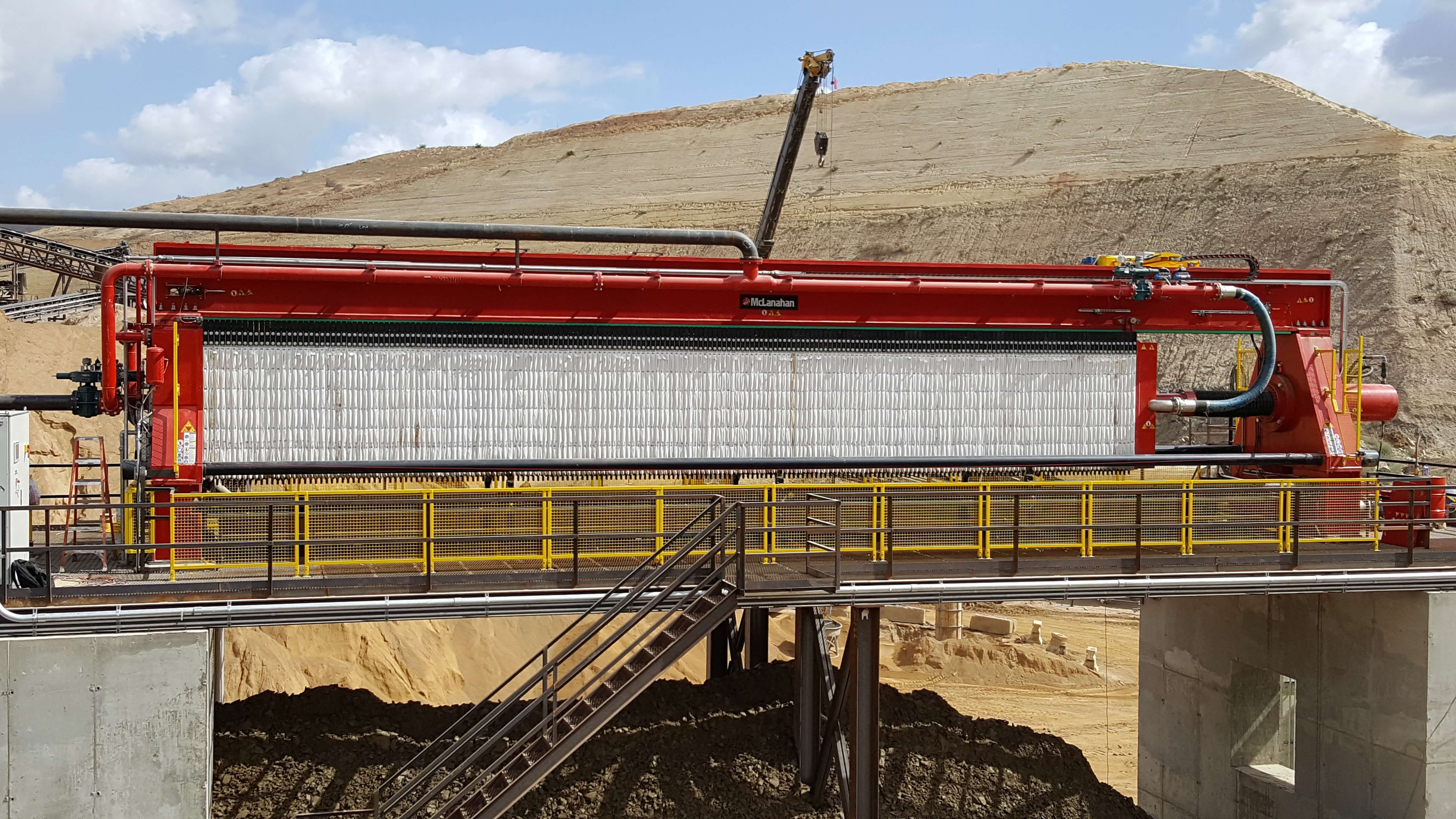
McLanahan Filter Presses
McLanahan Filter Presses
High-Pressure Dewatering and Solid-Liquid Separation
McLanahan Filter Presses are designed to dewater fine material slurries and separate solids from liquids through high-pressure mechanical filtration.
Filter Presses are widely used in mining, aggregates, coal, concrete and Frac Sand applications to produce a relatively dry, easily managed filter cake while recovering clean, reusable process water.
The system pumps slurry at high pressure into chambers formed between hydraulically closed filter plates. Filter cloths retain the solids while allowing the filtrate water to pass through.
How McLanahan Filter Presses Work
A Filter Press consists of a series of recessed or membrane filter plates lined with filter cloths.
The plates are hydraulically clamped together to form sealed chambers between adjacent plates.
A high-pressure slurry feed pump then forces the slurry into these chambers.
As the slurry fills the chambers:
-
Solid particles are retained by the filter cloth
-
Water passes through the filter cloth
-
The filtrate exits through ports in the filter plates
-
Solids gradually accumulate inside the chambers
-
A dewatered filter cake is formed
Once the chambers are full, the slurry feed pump stops.
The hydraulic pressure holding the plates together is released and the plates are opened. The dewatered filter cakes then discharge by gravity.
The basic process can be summarized as:
Slurry Feed → High-Pressure Pumping → Filtration → Water Recovery → Filter Cake Discharge
Unlike some other dewatering technologies, the filter plates do not continuously squeeze the material during the filtration cycle. Dewatering occurs primarily because the slurry is pumped into the chambers at high pressure, forcing liquid through the filter cloth while the solids are retained.
Recessed Plate and Membrane Plate Technology
McLanahan Filter Presses can use either recessed plates or membrane plates.
Recessed Plates
Recessed plates create chambers in which the slurry solids accumulate during the filtration cycle.
The feed pump pressure drives the liquid through the filter cloth while the solids remain in the chamber and form the filter cake.
Membrane Plates
Membrane plates operate similarly to recessed plates but include flexible membrane surfaces.
After the chambers are filled and the initial dewatering stage is completed, air or water can be introduced behind the membrane to expand it and compress the filter cake.
This additional compression can remove more water from compressible materials and further increase cake solids.
Dry, Drip-Free Filter Cake
One of the major benefits of a McLanahan Filter Press is the ability to produce a relatively dry and drip-free filter cake.
The final cake moisture depends on:
-
Feed solids concentration
-
Particle size distribution
-
Material permeability
-
Specific gravity
-
Cake thickness
-
Feed pressure
-
Filter cloth selection
-
Filtration cycle time
-
Material characteristics
The resulting cake is easier to handle, transport, stockpile and dispose of than untreated slurry.
Recovery of Reusable Water
The liquid passing through the filter cloth is collected as filtrate water.
This water can often be returned to the process, reducing the requirement for fresh water.
Water recovery can help:
-
Reduce fresh-water consumption
-
Improve water recycling
-
Reduce the volume of liquid sent to ponds
-
Support closed-loop wet processing
-
Reduce water management costs
McLanahan specifically highlights the recovery of immediately reusable process water as a major advantage of its Filter Press technology.
Tailings and Pond Reduction
Filter Presses are particularly valuable in applications where fine material is currently being sent to settling ponds or tailings storage facilities.
By mechanically dewatering the slurry, the Filter Press converts wet slurry into a manageable filter cake.
This can help operators:
-
Reduce tailings volume
-
Reduce tailings moisture
-
Extend pond life
-
Reduce or eliminate settling pond requirements in some applications
-
Reduce transportation and disposal costs
-
Improve site utilization
-
Recover process water
McLanahan identifies settling pond reduction or elimination as one of the potential benefits of Filter Press systems.
Overhead Beam Filter Presses
McLanahan Overhead Beam Filter Presses are designed primarily for larger-volume applications.
The filter plates are suspended from an overhead I-beam, providing excellent access to the plates and filter cloths.
The overhead beam design allows the plates to open with minimal obstruction, promoting reliable cake discharge and simplifying inspection, cleaning and maintenance.
These Filter Presses are particularly suitable for:
-
High-volume tailings
-
Difficult-to-dewater slurries
-
Fine particle applications
-
High-clay materials
-
Mining tailings
-
Large aggregate washing operations
McLanahan states that the Overhead Beam design is particularly suited to larger processing volumes and difficult-to-dewater materials.
Side Beam Filter Presses
Side Beam Filter Presses use support beams positioned on the sides of the filter plates.
They are generally suited to lower-volume applications and offer a compact and more portable design.
The Side Beam configuration can be advantageous for:
-
Smaller throughput requirements
-
Mineral concentrates
-
Smaller tailings applications
-
Portable installations
-
Applications requiring lower installation height
McLanahan describes the Side Beam design as a lower-cost and more portable alternative to the larger Overhead Beam configuration.
High Level of Automation
McLanahan Filter Presses can be equipped with automated controls to manage the filtration cycle.
Automation can control functions such as:
-
Plate closing
-
Slurry feeding
-
Filtration
-
Feed pressure
-
Plate opening
-
Cake discharge
-
Filter cloth washing
-
Core blow
-
Fault monitoring
-
Safety systems
Remote monitoring and assistance can also be incorporated into the control system.
McLanahan uses a single hydraulic cylinder in its Filter Press designs, helping reduce mechanical complexity while providing reliable automated operation.
Filter Cloth Selection
Filter cloth selection is critical to Filter Press performance.
The appropriate cloth depends on:
-
Particle size
-
Material chemistry
-
Slurry characteristics
-
Required filtration rate
-
Cake release requirements
-
Abrasion resistance
-
Desired cake moisture
Common filter cloth materials include polypropylene, nylon and polyester.
Material testing is recommended to determine the most suitable filter cloth and operating conditions for a specific application.
No Chemical Additives Typically Required
McLanahan Filter Presses can achieve mechanical dewatering through high-pressure filtration without requiring flocculants or coagulants in many applications.
This can reduce chemical consumption compared with certain alternative dewatering technologies.
The exact requirement for chemicals depends on the material and application.
Applications
McLanahan Filter Presses are suitable for:
-
Mining tailings
-
Aggregate wash-plant effluent
-
Coal tailings
-
Mineral concentrates
-
Frac Sand
-
Concrete
-
Industrial minerals
-
Fine material slurries
-
Process waste
-
Water and tailings management
They can be used downstream of equipment such as Thickeners and Clarifiers to mechanically dewater the resulting underflow slurry.
Key Features & Benefits
-
High-pressure mechanical dewatering
-
Solid-liquid separation
-
Produces a drip-free filter cake
-
Recovers reusable process water
-
Reduces tailings moisture
-
Can reduce settling pond requirements
-
Reduces waste volume
-
Suitable for fine and difficult-to-dewater materials
-
Recessed or membrane plate options
-
Overhead Beam and Side Beam configurations
-
Automated operation
-
Remote monitoring capability
-
High-pressure slurry feeding
-
Wide plate openings for easier maintenance
-
Efficient cake discharge
-
Filter cloth washing options
-
Core blow system
-
Designed according to application-specific material testing
Factors Affecting Filter Press Performance
Filter Press performance depends on:
-
Feed slurry solids concentration
-
Particle size distribution
-
Material permeability
-
Specific gravity
-
Cake thickness
-
Filter cloth characteristics
-
Feed pressure
-
Pump capacity
-
Filtration cycle time
-
Material chemistry
-
Slurry temperature
-
Required final cake moisture
McLanahan recommends material testing before sizing a Filter Press for a specific application because slurry characteristics can significantly affect dewatering performance.
Designing the Right Filter Press
Important information required for Filter Press selection includes:
-
Feed capacity
-
Slurry flow rate
-
Feed solids concentration
-
Particle size distribution
-
Material specific gravity
-
Slurry density
-
Required cake moisture
-
Required cake thickness
-
Required filtration capacity
-
Number of operating cycles
-
Available operating hours
-
Filter cloth requirements
-
Water recovery requirements
-
Existing Thickener or Clarifier
-
Existing slurry pumps
-
Available installation area
-
Electrical power availability
-
Desired level of automation
Laboratory or pilot testing can be used to determine the appropriate plate size, number of plates, chamber thickness, filter cloth and operating cycle.
McLanahan Filter Presses from Cube Solutions
As a McLanahan agent, Cube Solutions provides solutions for mechanical dewatering, tailings management, water recovery and solid-liquid separation.
Our team can evaluate your slurry characteristics and process requirements and assist in selecting the appropriate McLanahan Filter Press configuration.
Contact Cube Solutions to discuss your dewatering and tailings management project and determine the most suitable McLanahan Filter Press for your operation.