
McLanahan UltraSAND Plants
McLanahan UltraSAND Plants
Integrated Sand Washing, Classification and Dewatering Solutions
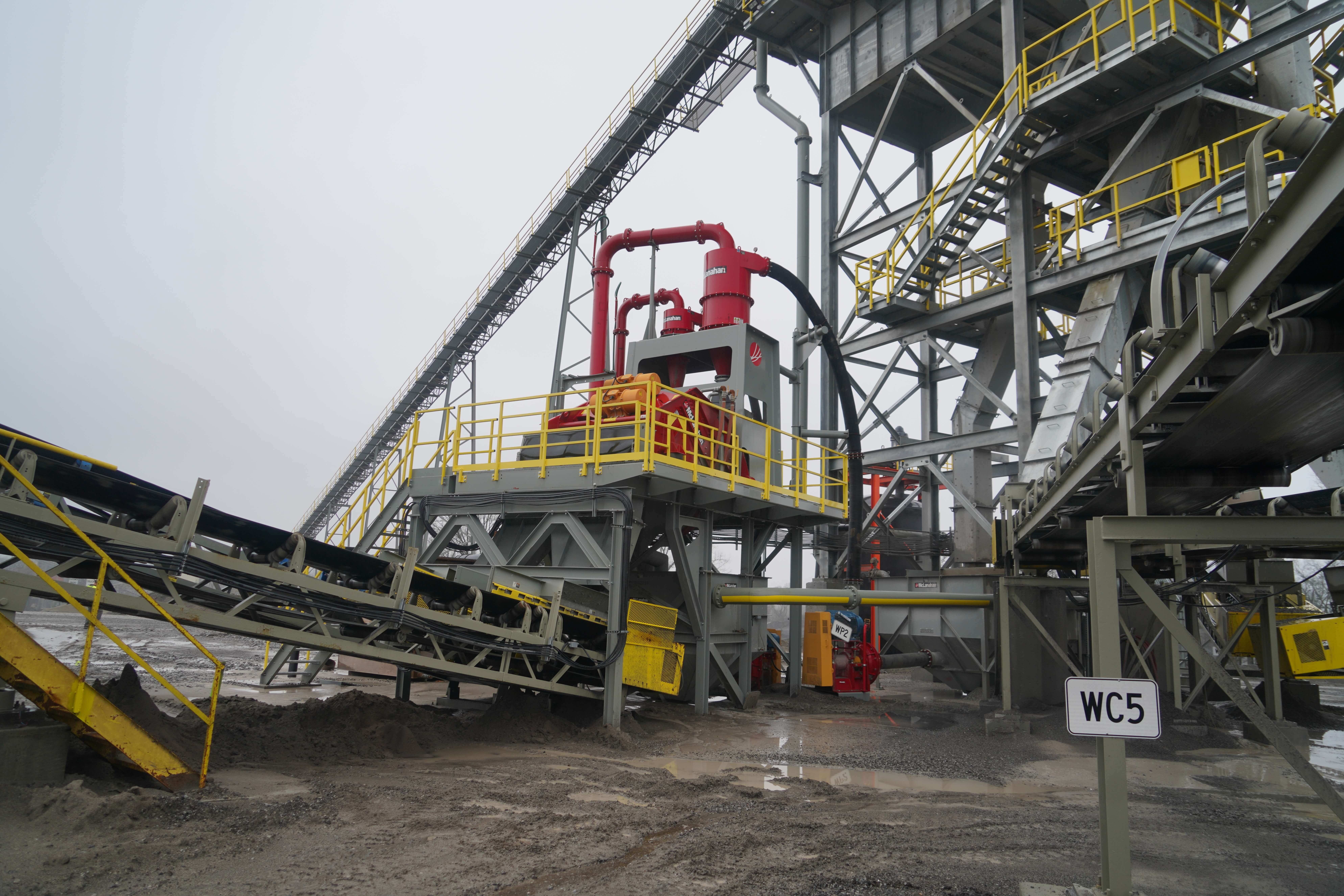
McLanahan UltraSAND Plants are integrated systems designed to wash, classify, recover and dewater sand while maximizing the recovery of usable product.
UltraSAND Plants combine McLanahan equipment such as Sumps, Slurry Pumps, Hydrocyclones or Separators and Dewatering Screens into a complete sand processing system.
The systems are suitable for a wide range of applications, from simple sand dewatering to multi-stage washing and classification of construction, industrial and specialty sands.
How UltraSAND Plants Work
UltraSAND Plants can be configured for different feed conditions. The two primary configurations are screen-fed and sump-fed systems.
In a screen-fed application, sand is directed onto a Dewatering Screen. The screen removes excess water and can also separate fine material from the desired sand product.
Material passing through the screen is collected and pumped to Hydrocyclones or Separators for further classification and dewatering.
The classified material is then returned to the Dewatering Screen to produce a dewatered final product.
A typical process can be summarized as:
Feed → Screening → Hydrocyclone/Separator → Dewatering Screen → Final Sand Product
In sump-fed applications, the slurry is first collected in a Sump and pumped to Hydrocyclones or Separators.
The Hydrocyclones remove unwanted fine material and partially dewater the sand. The underflow is then discharged onto the Dewatering Screen, where additional water is removed.
The final sand product leaves the Dewatering Screen in a drip-free condition.
Sand Washing and Dewatering
UltraSAND Plants are commonly used to wash and dewater:
-
Concrete sand
-
Mason sand
-
Manufactured sand
-
Natural sand
-
Industrial sand
-
Frac sand
-
Foundry sand
-
Glass sand
-
Other specialty sands
The system can remove unwanted fine material while recovering the desired sand fraction.
The Dewatering Screen produces a significantly drier product than many conventional sand washing systems, depending on the characteristics of the material.
Hydrocyclone and Separator Classification
Hydrocyclones and McLanahan Separators can be used to classify the sand and remove undesirable ultrafine material.
This provides improved separation efficiency and helps maximize the recovery of usable sand.
The classification stage can be configured according to:
-
Required product size
-
Feed gradation
-
Fines content
-
Desired recovery
-
Product specifications
-
Number of final products
Producing Multiple Sand Products
UltraSAND Plants can be configured to process multiple sand streams and, in certain applications, produce more than one final product.
A Dewatering Screen can be divided into coarse and fine sections, allowing different sand fractions to be processed separately.
Blending arrangements can also be incorporated where required to adjust the final product gradation.
This provides flexibility when feed characteristics or customer requirements change.
Higher Sand Recovery
One of the major advantages of an UltraSAND Plant is its ability to recover a high percentage of usable sand.
The system is designed to minimize the amount of specification-quality sand lost to the process-water or fines stream.
Improved recovery can result in:
-
Higher product yield
-
Less valuable sand lost to ponds
-
Better utilization of the deposit
-
Reduced waste
-
Improved plant economics
Drier Final Product
The Dewatering Screen removes excess water from the classified sand before it leaves the plant.
The resulting product is discharged in a drip-free condition, making it suitable for conveying and stockpiling.
A drier product can provide:
-
Faster handling
-
Earlier use of the product
-
Steeper stockpile angles
-
Greater stockpile capacity
-
Reduced water loss
-
Improved housekeeping
Actual final moisture depends on the material characteristics and operating conditions. McLanahan notes that typical C-33 sands may be around 12–15% moisture by weight, while coarser concrete sands can dewater to approximately 7% under suitable conditions.
Modular UltraSAND Plants
McLanahan also offers Modular UltraSAND Plants designed for quick setup and installation.
These compact, skid-mounted systems use field-proven McLanahan equipment and can be transported and installed with reduced site preparation requirements.
Modular UltraSAND Plants can also be combined with other McLanahan modular systems, including:
-
UltraCRUSH
-
UltraWASH
-
UltraSCRUB
-
EcoCycle
-
Other wet-processing modules
This allows producers to create a complete modular processing plant.
Configurable UltraSAND Plants
McLanahan Configurable UltraSAND Plants provide a tailored solution while maintaining a standardized plant design.
Different Hydrocyclone clusters can be selected according to the specific application and desired product requirements.
This approach can provide a faster and more flexible solution than a fully custom-designed plant while still allowing the equipment configuration to match the process.
Applications
McLanahan UltraSAND Plants are suitable for:
-
Aggregate washing
-
Concrete sand
-
Manufactured sand
-
Natural sand
-
Frac sand
-
Industrial sand
-
Foundry sand
-
Glass sand
-
Mining
-
Coal
-
Specialty sands
-
Construction materials
UltraSAND Plants are particularly suited to applications where washing, classification and dewatering are required within an integrated system.
Key Features & Benefits
-
Integrated sand washing and dewatering
-
Hydrocyclone or Separator-based classification
-
High recovery of usable sand
-
Drier final product
-
Reduced loss of specification-quality sand
-
Reduced water loss
-
Improved stockpile capacity
-
Drip-free final product
-
Flexible process configuration
-
Suitable for single or multiple sand products
-
Modular and configurable options
-
Compact equipment arrangement
-
Can be integrated with complete wet-processing plants
-
Designed using McLanahan field-proven equipment
-
Suitable for new plants and plant upgrades
Factors Affecting UltraSAND Plant Performance
Plant performance depends on:
-
Feed capacity
-
Feed particle size distribution
-
Sand content
-
Fines content
-
Clay and silt content
-
Material density
-
Particle shape
-
Feed moisture
-
Slurry concentration
-
Water flow
-
Required product size
-
Desired product gradation
-
Required recovery
-
Desired final moisture
-
Classification requirements
-
Dewatering requirements
Designing the Right UltraSAND Plant
The correct UltraSAND configuration should be selected based on the characteristics of the feed material and the required final products.
Important information includes:
-
Feed capacity (TPH)
-
Feed particle size distribution
-
Bulk density
-
Sand percentage
-
Clay and silt content
-
Fines percentage
-
Required product sizes
-
Required product gradation
-
Number of final products
-
Desired sand recovery
-
Required product moisture
-
Water availability
-
Slurry flow rate
-
Existing washing equipment
-
Existing classification equipment
-
Existing dewatering equipment
-
Available plant area
-
Downstream conveying and stockpiling requirements
Material testing may be recommended to determine the optimum Hydrocyclone, Separator and Dewatering Screen configuration.
McLanahan UltraSAND Plants from Cube Solutions
As a McLanahan agent, Cube Solutions provides integrated solutions for sand washing, classification, recovery and dewatering.
Our team can evaluate your feed material and final product requirements and assist in developing the appropriate McLanahan UltraSAND Plant configuration.
Contact Cube Solutions to discuss your sand processing project and determine the most suitable UltraSAND solution for your operation.