
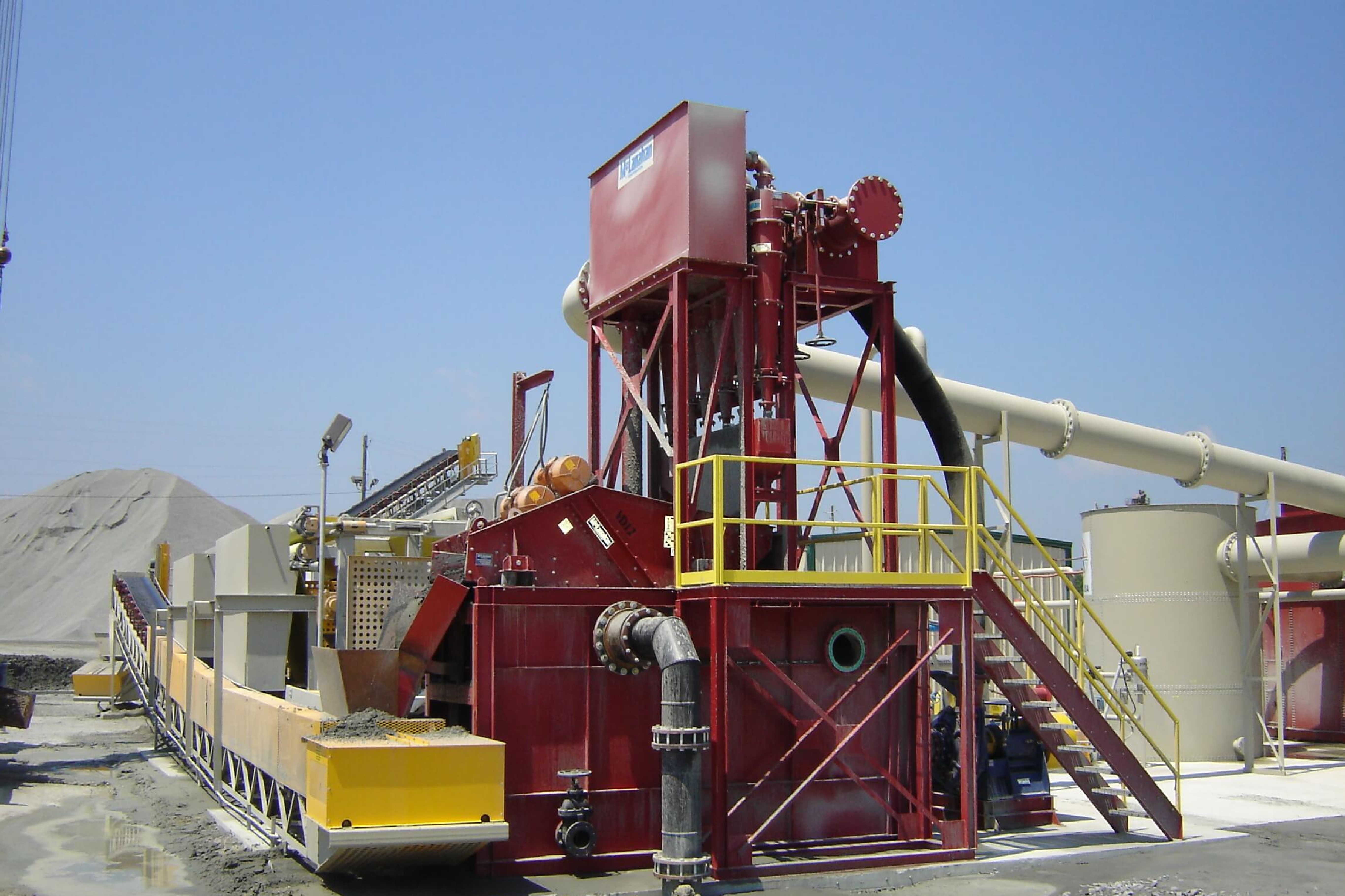
McLanahan UltraFINES Recovery Systems
McLanahan UltraFINES Recovery Systems
Recover Fine Material. Reduce Waste. Maximize Sand Recovery.
McLanahan UltraFINES Recovery Systems (UFR) are designed to recover fine solids from wash plant effluent streams that would otherwise be lost to settling ponds or tailings systems.
The system combines a sump, slurry pump, Hydrocyclones and a Dewatering Screen into an integrated module designed to recover nominally +400 mesh (38 µm) solids.
The recovered material is discharged as a dewatered, drip-free product that can be conveyed and stockpiled and, depending on its characteristics, may be suitable for sale or use as a secondary product.
How UltraFINES Recovery Systems Work
Wash plant effluent containing fine sand and other solids is directed into the UFR sump.
A McLanahan slurry pump then pumps the slurry at the required pressure to a bank of Hydrocyclones.
The Hydrocyclones separate the finer solids from the process water and recover most of the material in the target size range as a partially dewatered underflow.
The Hydrocyclone underflow is then directed to a Dewatering Screen, which removes additional water and produces a conveyable and stackable product.
The basic process can be summarized as:
Wash Plant Effluent → Sump → Slurry Pump → Hydrocyclones → Dewatering Screen → Recovered Fine Product
Water and particles that pass through the Dewatering Screen can be recirculated through the Hydrocyclones, creating a recovery circuit that helps maximize the recovery of valuable fine material.
Recovering Fine Sand Before It Reaches the Pond
Conventional washing processes can send valuable fine sand and other solids to a settling pond.
Once this material enters the pond, recovering it can require significant time, equipment and operating costs.
An UltraFINES Recovery System captures a significant portion of these solids before they reach the settling pond.
This can help:
-
Reduce solids reporting to the pond
-
Extend pond life
-
Reduce pond cleanout requirements
-
Reduce the volume of material requiring tailings management
-
Recover potentially valuable product
-
Improve overall plant material recovery
Dewatered and Stackable Product
One of the key advantages of the UFR system is that the recovered fines are discharged from the Dewatering Screen in a drip-free condition.
The final moisture content depends on the characteristics of the material, including particle size, specific gravity and surface properties.
McLanahan states that typical UFR products can have approximately 20–25% moisture by weight for materials with a specific gravity of 2.7, while remaining drip-free and suitable for conveying and stockpiling.
No Added Chemicals
McLanahan UltraFINES Recovery Systems recover fine material using mechanical separation and dewatering without the need for added chemicals.
This makes UFR systems an attractive solution for operations looking to recover fine sand while keeping the process simple and minimizing chemical requirements.
Reducing Settling Pond Requirements
Recovering fines before they enter the settling pond can significantly reduce the solids loading on the pond.
This can help operators:
-
Extend the operating life of existing ponds
-
Reduce pond maintenance
-
Reduce the frequency of pond cleanout
-
Reduce the amount of fine material requiring storage
-
Make better use of available land
-
Reduce downstream solids loading
In some applications, fines recovery can also reduce the load on downstream thickening and filtration equipment.
Potentially Saleable Fine Product
The recovered material does not necessarily have to be treated as waste.
Depending on its particle size, mineral composition, cleanliness and market requirements, the recovered fines may be used as a standalone product or as a secondary product.
Potential applications include:
-
Fine sand
-
Utility backfill
-
Pipe sand
-
Industrial sands
-
Frac sand
-
Aggregate fines
-
Iron ore fines
-
Coal recovery
-
Ash
-
Other fine mineral materials
McLanahan identifies applications for UFR systems across aggregates, coal, concrete, frac sand and mining.
Closed-Circuit Fine Material Recovery
The UFR system can operate as a recovery circuit in which material passing through the Dewatering Screen is returned to the Hydrocyclones.
This recirculation helps recover additional fine particles and maximize the amount of usable material captured from the wash plant effluent.
The objective is to recover as much valuable fine material as practical while sending predominantly finer material to the downstream waste or settling system.
Applications
McLanahan UltraFINES Recovery Systems are suitable for applications including:
-
Sand washing
-
Aggregate washing
-
Frac sand processing
-
Mining
-
Mineral processing
-
Coal recovery
-
Industrial sands
-
Concrete aggregates
-
Iron ore processing
-
Ash recovery
-
Fine material recovery
-
Tailings management
Key Features & Benefits
-
Recover fine solids from wash plant effluent
-
Designed to recover nominally +400 mesh (38 µm) material
-
Integrated Sump, Pump, Hydrocyclones and Dewatering Screen
-
No added chemicals required for the recovery process
-
Produce a conveyable and stackable recovered product
-
Reduce fine solids reporting to settling ponds
-
Extend settling pond life
-
Reduce pond cleanout requirements
-
Recover potentially saleable material
-
Improve overall plant yield
-
Reduce downstream solids loading
-
Compact and integrated system design
-
Suitable for new plants and existing wash plants
Factors Affecting UFR Performance
Actual recovery performance depends on several factors, including:
-
Feed particle size distribution
-
Solids concentration
-
Slurry density
-
Material specific gravity
-
Material characteristics
-
Clay content
-
Particle shape
-
Water flow
-
Pump pressure
-
Hydrocyclone configuration
-
Dewatering Screen performance
-
Required recovery size
-
Operating conditions
No classification or recovery system is 100% efficient. McLanahan notes that UFR overflow is typically around 85–90% passing 400 mesh (38 µm), depending on the solids gradation.
Designing the Right UltraFINES Recovery System
The UFR system should be selected according to the characteristics of the wash plant effluent and the required recovery target.
Important design information includes:
-
Wash plant capacity
-
Effluent flow rate
-
Solids concentration
-
Feed particle size distribution
-
Percentage of material above 38 µm
-
Material specific gravity
-
Slurry density
-
Required recovery
-
Desired final product moisture
-
Water flow
-
Pumping requirements
-
Available installation area
-
Existing settling pond capacity
-
Existing Hydrocyclone and dewatering equipment
-
Desired final product application
Laboratory or pilot testing may be recommended to determine expected recovery and final product characteristics.
McLanahan UltraFINES Recovery Systems from Cube Solutions
As a McLanahan agent, Cube Solutions provides solutions for fines recovery, sand washing, classification, dewatering, slurry pumping and water and tailings management.
Our team can evaluate your wash plant effluent and help determine whether an UltraFINES Recovery System can recover valuable fine material, reduce pond loading and improve overall plant efficiency.
Contact Cube Solutions to discuss your fines recovery application and determine the most suitable McLanahan UFR solution for your operation.