
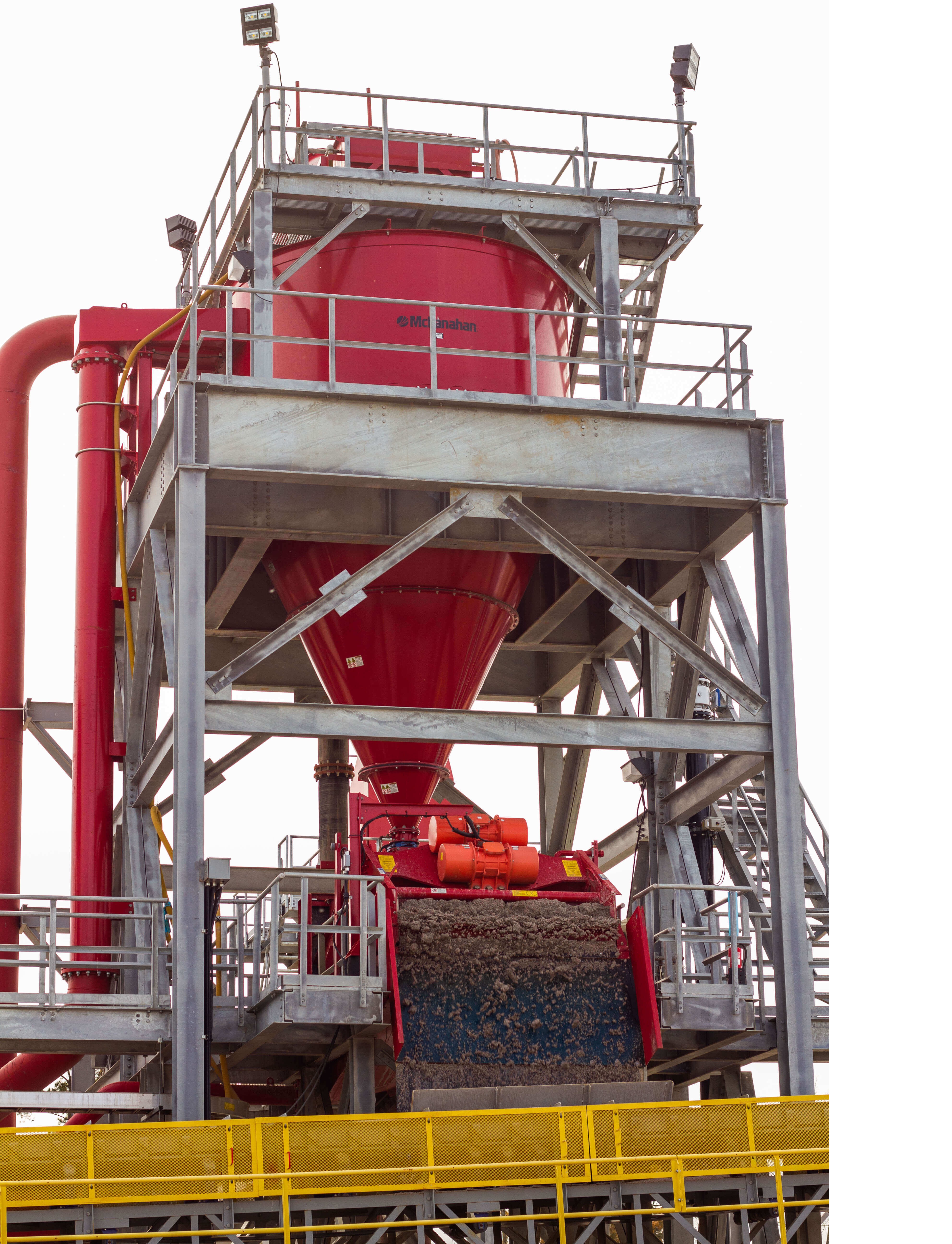
McLanahan Hydrosizers
McLanahan Hydrosizers
Efficient Wet Classification for Sand, Aggregates and Mineral Processing
McLanahan Hydrosizers are wet classification systems designed to separate particles according to their settling characteristics in water.
Hydrosizers use controlled upward water flow to classify particles by size and density. Coarser and heavier particles settle through the water while finer and lighter particles remain suspended and are carried toward the overflow.
This controlled classification process allows producers to achieve a more consistent and accurately sized product while removing unwanted fines.
Hydrosizers are particularly useful in sand processing, aggregate washing, mineral processing and applications where accurate wet classification is required.
How McLanahan Hydrosizers Work
Feed material is introduced into the Hydrosizer as a water-based slurry.
Inside the classification chamber, water is introduced upward through the material at a controlled velocity.
The upward water flow creates a classification zone in which particles behave according to their size, density and settling characteristics.
Coarser and denser particles settle through the water and are collected toward the bottom of the unit.
Finer and lighter particles remain suspended in the upward-flowing water and are carried toward the overflow.
The classified material can then be discharged as separate fractions for further processing or final product use.
The process can be summarized as:
Slurry Feed + Controlled Upward Water Flow + Particle Classification + Size Separation
Wet Particle Classification
The main function of a Hydrosizer is to classify particles in a wet environment.
Unlike simple screening, which separates particles primarily according to their physical size, wet classification also takes particle density and settling characteristics into consideration.
This makes Hydrosizers useful when conventional screening alone cannot achieve the required product specification.
Controlled Classification
Hydrosizers provide controlled separation by regulating the upward water flow through the classification chamber.
The operating conditions can be adjusted to achieve the desired classification performance.
The classification process can help:
-
Remove unwanted fines
-
Separate different particle fractions
-
Control product gradation
-
Improve sand quality
-
Prepare material for downstream processing
-
Produce more consistent products
Sand Classification
Hydrosizers are particularly useful in sand processing applications.
They can separate fine unwanted material from the desired sand fraction and help control the final product gradation.
This can be especially important for applications where product specifications require controlled amounts of fine material.
Hydrosizers can be integrated with:
-
Screens
-
Hydrocyclones
-
Dewatering screens
-
Sand pumps
-
Slurry tanks
-
Other washing and classification equipment
Aggregate and Mineral Processing
Hydrosizers can be used in aggregate and mineral processing plants to classify wet material into controlled size fractions.
Depending on the process design, classified products can be directed to additional washing, dewatering or mineral separation stages.
Potential applications include:
-
Sand classification
-
Aggregate washing
-
Mineral processing
-
Industrial minerals
-
Fine particle separation
-
Product sizing
-
Desliming
-
Feed preparation
Separation by Settling Characteristics
The classification process is based on how particles behave while settling through water.
Particle settling is influenced by several factors, including:
-
Particle size
-
Particle density
-
Particle shape
-
Water velocity
-
Slurry concentration
By controlling the upward water velocity, the Hydrosizer can influence which particles settle and which remain suspended.
Product Quality Improvement
Excessive fines can negatively affect the quality and performance of many aggregate and sand products.
Hydrosizers can help remove unwanted fine material and produce a more controlled product.
This can contribute to:
-
Improved product consistency
-
Better control of particle size distribution
-
Reduced unwanted fines
-
Improved downstream processing
-
Compliance with product specifications
Applications
McLanahan Hydrosizers are suitable for applications including:
-
Sand washing
-
Sand classification
-
Aggregate processing
-
Mining
-
Mineral processing
-
Industrial minerals
-
Fine particle separation
-
Desliming
-
Wet classification
-
Product sizing
-
Feed preparation
Typical materials may include:
-
Natural sand
-
Manufactured sand
-
Silica sand
-
Gravel
-
Crushed stone
-
Limestone
-
Industrial minerals
-
Mineral ores
-
Other water-based slurry materials
Key Features & Benefits
-
Efficient wet particle classification
-
Controlled upward water flow
-
Separation based on settling characteristics
-
Helps remove unwanted fines
-
Produces controlled particle fractions
-
Helps improve product consistency
-
Suitable for sand and aggregate applications
-
Suitable for mineral processing
-
Continuous classification
-
Can be integrated into complete washing plants
-
Can work alongside screens and hydrocyclones
-
Compact and efficient classification solution
Factors Affecting Hydrosizer Performance
Actual classification performance depends on several factors, including:
-
Feed rate
-
Feed particle size distribution
-
Particle density
-
Particle shape
-
Slurry concentration
-
Water flow rate
-
Upward water velocity
-
Feed consistency
-
Desired cut size
-
Overflow characteristics
-
Underflow characteristics
-
Material settling behavior
-
Downstream process requirements
Proper equipment sizing and process design are essential to achieving consistent classification performance.
Selecting the Right Hydrosizer
The appropriate Hydrosizer should be selected based on:
-
Material type
-
Required capacity (TPH)
-
Feed particle size distribution
-
Particle density
-
Slurry concentration
-
Required cut size
-
Desired product gradation
-
Water availability
-
Required overflow quality
-
Required underflow characteristics
-
Downstream equipment
-
Overall process flowsheet
Testing may be recommended where precise classification performance or product specifications need to be established.
Cube Solutions can evaluate your application requirements and assist in selecting the appropriate McLanahan Hydrosizer configuration.
McLanahan Hydrosizers from Cube Solutions
As a McLanahan agent, Cube Solutions provides washing, classification, feeding, crushing, screening and mineral processing solutions for customers in Egypt and the region.
Our services include equipment selection, application evaluation, technical support and supply of McLanahan equipment.
Contact Cube Solutions to discuss your Hydrosizer application and determine the most suitable configuration for your operation.