
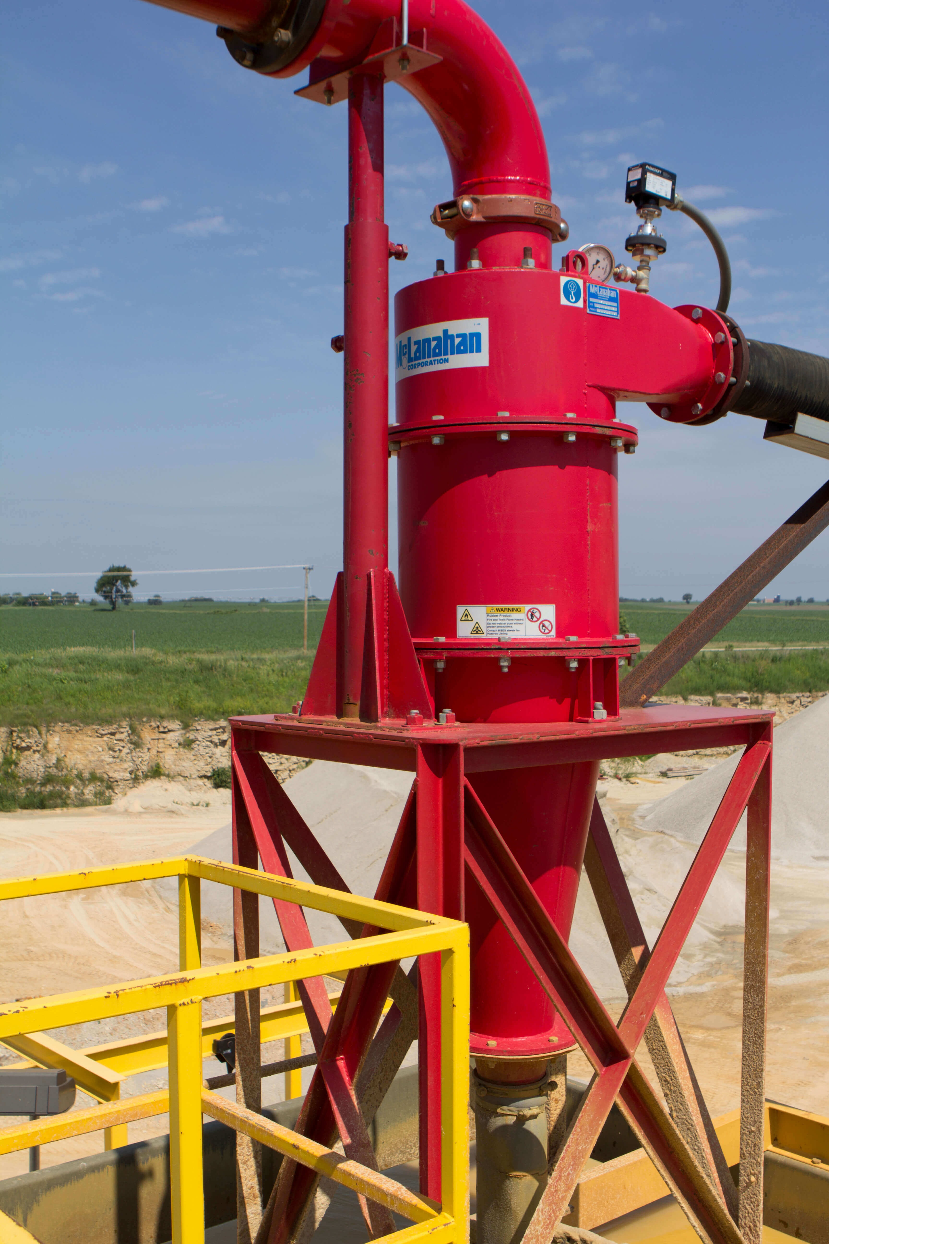
McLanahan Hydrocyclones
McLanahan Hydrocyclones
Efficient Classification and Separation of Fine and Coarse Particles
McLanahan Hydrocyclones are compact, high-efficiency separation devices used to classify and separate particles according to their size and density.
Hydrocyclones use centrifugal forces generated within a rotating slurry flow to separate coarse and fine particles. They are widely used in mineral processing, aggregate washing, sand processing and other applications where efficient particle classification and fines removal are required.
Hydrocyclones can be used as part of a complete washing and classification circuit or as a standalone classification stage within a mineral processing plant.
How McLanahan Hydrocyclones Work
A slurry containing water and solid particles enters the hydrocyclone tangentially under pressure.
The tangential entry creates a high-speed swirling flow inside the cylindrical and conical body of the hydrocyclone.
Centrifugal forces push the coarser and denser particles toward the outer wall, while finer and lighter particles remain closer to the center of the vortex.
The coarse particles move downward along the wall toward the apex and are discharged as the underflow.
The finer particles move toward the center of the hydrocyclone and are carried upward through the vortex finder as the overflow.
The process can be summarized as:
Slurry Feed + Centrifugal Separation + Particle Classification + Underflow / Overflow Separation
Particle Classification
The primary function of a Hydrocyclone is particle classification.
It separates material into different size fractions without the use of moving mechanical parts inside the cyclone.
The classification point depends on the hydrocyclone design and operating conditions.
Hydrocyclones can therefore be used to:
-
Separate coarse and fine particles
-
Remove unwanted fines
-
Deslime material
-
Prepare feed for downstream processing
-
Control particle size distribution
-
Recover or concentrate desired particle fractions
Underflow and Overflow
A Hydrocyclone produces two separate discharge streams:
Underflow:
The underflow contains the coarser and/or denser fraction of the feed and is discharged through the apex at the bottom of the hydrocyclone.
Overflow:
The overflow contains the finer and/or lighter fraction and exits through the vortex finder at the top of the hydrocyclone.
The two streams can then be directed to different stages of the processing plant.
Desliming
Hydrocyclones are widely used for desliming applications.
Fine clay, silt and other very fine particles can negatively affect downstream processing and final product quality.
A hydrocyclone can separate these unwanted fines from the coarser product, allowing the fines to be removed through the overflow stream.
This makes hydrocyclones particularly useful in sand and aggregate washing applications.
Sand Classification
Hydrocyclones are commonly used in sand processing to separate fine particles from the desired sand fraction.
They can help produce a more controlled and consistent product by removing excess fines and controlling the particle size distribution.
In a complete sand washing plant, hydrocyclones can work together with:
-
Sand pumps
-
Screens
-
Dewatering screens
-
Slurry tanks
-
Separators
-
Other washing and classification equipment
Dewatering Applications
Depending on the process configuration, hydrocyclones can also contribute to the removal of water from coarse solids by concentrating solids into the underflow.
For applications requiring a lower moisture product, hydrocyclones may be combined with dewatering screens or other dewatering equipment.
Mining and Mineral Processing
Hydrocyclones are widely used in mineral processing circuits where particle classification is required.
They can be used before or after various processing stages, depending on the process flowsheet.
Potential applications include:
-
Ore classification
-
Desliming
-
Grinding circuit classification
-
Mineral processing
-
Sand processing
-
Aggregate washing
-
Tailings processing
-
Fine particle separation
-
Feed preparation
Applications
McLanahan Hydrocyclones are suitable for applications including:
-
Aggregate washing
-
Sand washing
-
Sand classification
-
Mining
-
Mineral processing
-
Ore classification
-
Desliming
-
Fines removal
-
Slurry classification
-
Tailings processing
-
Industrial minerals
-
Construction materials processing
Typical materials may include:
-
Sand
-
Gravel
-
Crushed stone
-
Limestone
-
Silica sand
-
Industrial minerals
-
Mineral ores
-
Clay-contaminated materials
-
Other slurry-based feed materials
Key Features & Benefits
-
Efficient centrifugal classification
-
Separation of fine and coarse particles
-
No moving mechanical parts inside the cyclone
-
Compact design
-
High-throughput classification
-
Effective fines removal
-
Suitable for desliming
-
Helps control particle size distribution
-
Can produce separate overflow and underflow streams
-
Suitable for continuous operation
-
Can be installed individually or in multiple-cyclone clusters
-
Suitable for mining, aggregate and sand processing
-
Can be integrated into complete washing and classification plants
Factors Affecting Hydrocyclone Performance
Hydrocyclone performance is affected by several operating and material parameters, including:
-
Feed rate
-
Feed pressure
-
Particle size distribution
-
Feed density
-
Solids concentration
-
Particle density
-
Particle shape
-
Slurry viscosity
-
Temperature
-
Hydrocyclone diameter
-
Apex size
-
Vortex finder size
-
Feed inlet configuration
-
Number of hydrocyclones operating in parallel
-
Required cut size
Proper operating conditions are essential for achieving consistent classification performance.
Selecting the Right Hydrocyclone
The appropriate Hydrocyclone configuration should be selected based on:
-
Material type
-
Required capacity
-
Feed particle size distribution
-
Required separation or cut size
-
Feed density
-
Solids concentration
-
Particle density
-
Slurry characteristics
-
Required overflow quality
-
Required underflow characteristics
-
Available feed pressure
-
Downstream process requirements
-
Overall process flowsheet
Multiple hydrocyclones can be arranged in clusters when higher capacities are required.
Testing and process evaluation may be recommended where precise classification performance is required.
Cube Solutions can evaluate your application requirements and assist in selecting the appropriate McLanahan Hydrocyclone configuration.
McLanahan Hydrocyclones from Cube Solutions
As a McLanahan agent, Cube Solutions provides washing, classification, feeding, crushing, screening and mineral processing solutions for customers in Egypt and the region.
Our services include equipment selection, application evaluation, technical support and supply of McLanahan equipment.
Contact Cube Solutions to discuss your Hydrocyclone application and determine the most suitable configuration for your operation.